Cornami makes Fully Homomorphic Encryption practical — production silicon that runs computation on encrypted data end to end. Data stays sealed through every operation, and the keys never leave your hands.
For the whole history of computing, trust has been borrowed — from reputations, contracts, intermediaries, and audits. Someone, somewhere, always had to be trusted with the data in the clear.
AI erases the last margin for that. Billions of autonomous agents will soon transact with one another, and every datapoint they touch is a candidate for training, leakage, or misuse. Policy and process can deter that. They cannot prevent it.
The future belongs to systems where trust is not assumed, enforced, or intermediated — but mathematically guaranteed.
FHE lets a computer operate directly on encrypted data — running the entire computation and returning an encrypted result — without ever decrypting it. Data stays sealed end to end. Keys stay hidden. The machine never sees what it is processing.
It has long been called the holy grail of cryptography, and for decades it stayed there: provably correct, far too slow to use. Our chief scientist, Dr. Craig Gentry, invented FHE. Cornami exists to make it fast enough for the real world.
Data is encrypted before it ever reaches the machine.
Every operation runs on the ciphertext. Nothing is decrypted.
Only the key holder can open the result.
Data stays encrypted. Keys stay hidden. Compute without compromise.
Today's public-key cryptography — RSA, elliptic curve — rests on math that quantum computers are expected to break. Encrypted data captured today can be stored and decrypted later, the moment that capability arrives. That clock is already running.
Governments are moving to get ahead of it. Federal policy now mandates the migration to post-quantum cryptography by 2030 — turning encrypted computation from a differentiator into a requirement.
Federal deadline for post-quantum cryptography
FHE is built on quantum-resistant foundations. The shift from optional to mandatory has already begun.
FHE runs orders of magnitude slower on CPUs and GPUs — general-purpose hardware was never built for it. Cornami closes the gap through hardware-algorithm co-design: the silicon and the cryptography are engineered together, not bolted on afterward. Three architectural properties make encrypted computation fast enough to deploy.
Every compute element fires on a compile-time-fixed cycle. Encrypted workloads finish in bounded, repeatable, knowable time — no tail latency.
p99.99 = p50
Compute, memory, and interconnect reconfigure in real time, so every stage of an encrypted computation runs on hardware purpose-built for it.
~1 ms full reconfigure · no reboot
Per-core independent sequencing means power follows activity, not capacity. Idle regions cost nothing.
Dataflow · no idle-cycle waste
Start with the markets that require encrypted computation. Expand into the many more that simply benefit from it. Wherever data is too sensitive to expose but too valuable to leave idle, FHE opens work that was previously out of reach.
Order matching, settlement, and risk computed on encrypted data — no leaked positions, no front-running, confidentiality public venues can't offer.
Train models and share results across institutions on patient data without ever exposing it.
Price on encrypted driving, location, and behavioral data — accurate models without surveillance.
Video and sensor analytics for hospitals, schools, and sensitive sites without exposing the underlying streams.
Detect fraud and systemic risk across institutions without any of them sharing customer records.
Autonomous agents that perceive, reason, act, and transact entirely on encrypted data. Your data, your agent, your privacy.
Cornami is not a chip company. We deliver end-to-end, application-specialized compute: custom silicon, system software, topology, and workload mapping — the full stack that runs encrypted workloads in production today, engineered to outcome rather than sold off the shelf.
A morphable, reconfigurable fabric of compute units with private local memory. Operator-level RAE, per-core SRAM structure, and four layers of interconnect all reconfigure under compiler control.
Stream-centric, not thread-centric. Describe a dataflow graph, start it, and the machine executes continuously with compiler-guaranteed reuse and forward compatibility across generations.
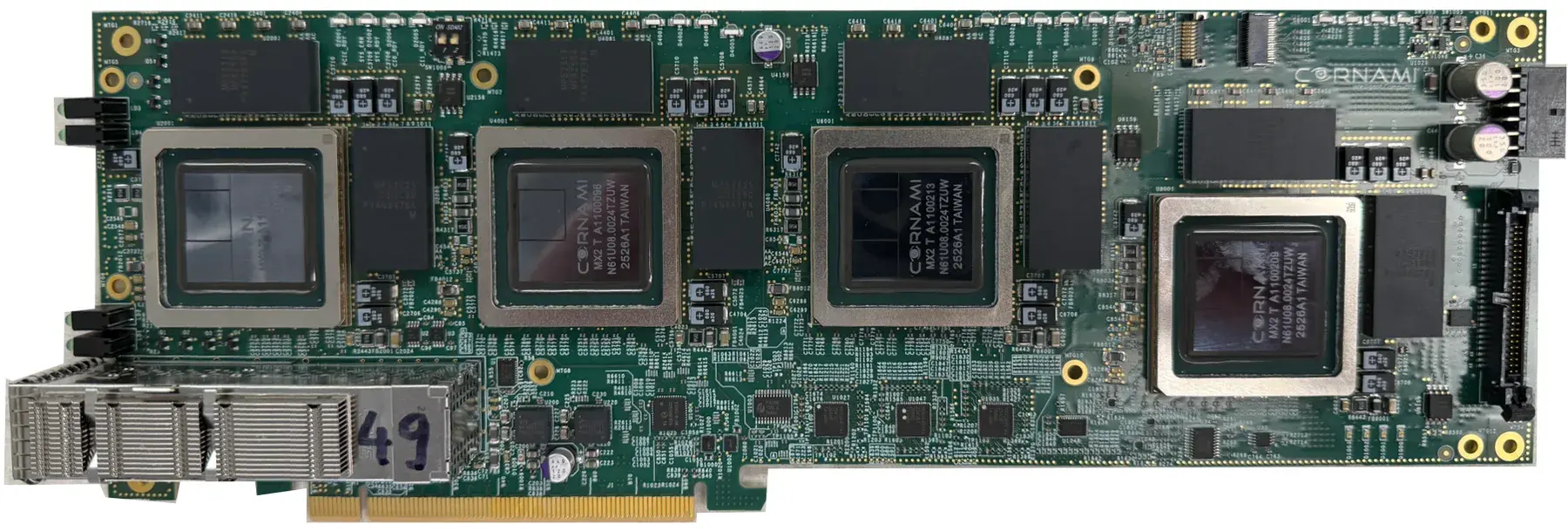
Our production ASIC. Full IEEE-754 floating point and integer support, with the numeric breadth needed for AI, signal processing, and cryptography on the same fabric.
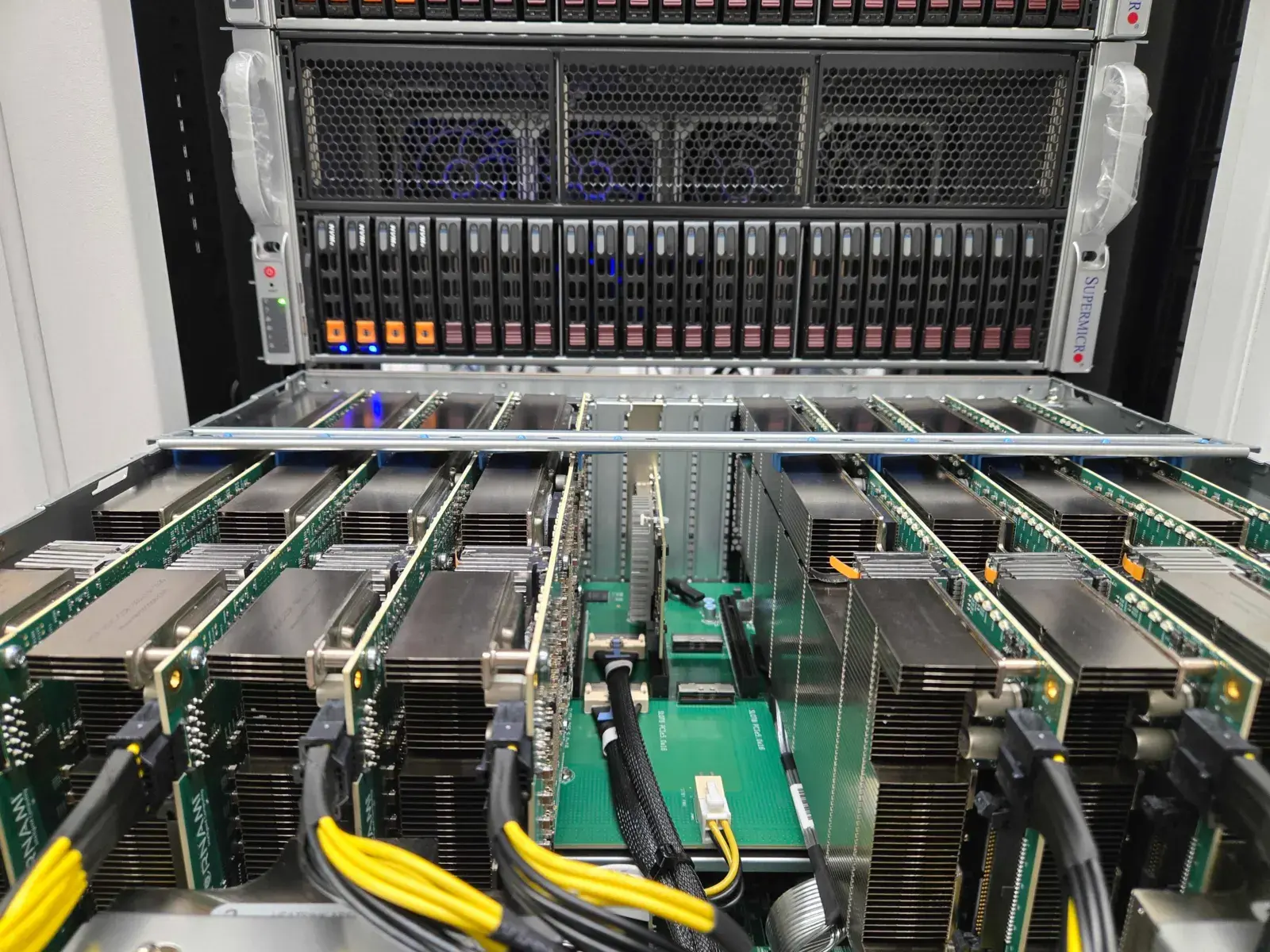
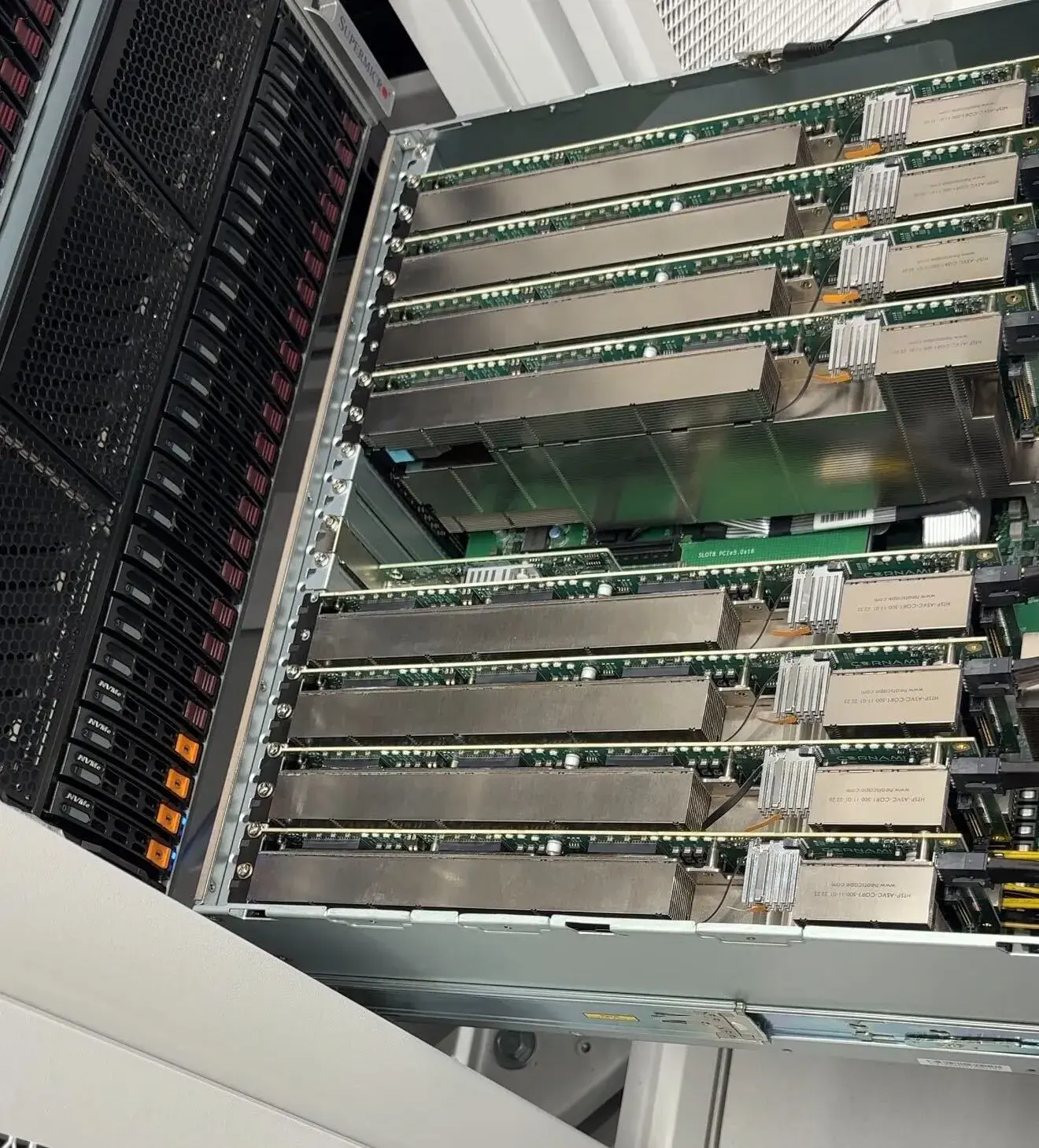
Rack-scale acceleration delivered and operating at customer sites. The full stack: silicon, software, and workload mapping, turnkey.
Ex-SoftBank Operating Partner · President, Sprint Business · CEO, Vodafone Global Enterprise
Inventor of FHE · MacArthur Fellow · Gödel Prize & ACM Hopper Award · ex-IBM Watson, Algorand
Configurable-compute pioneer · CORDIC paper (1,000+ citations) · ex-Raytheon, NASA/JPL
26+ years in embedded systems · ex-VP Engineering, YesVideo & Vidomi
Former CTO, TierPoint / Xand
Ex-VP, Inpher (FHE) · Enterprise GM, DemystData · McKinsey & Company